Here the application presents historical and forecasted key figures for the company.
The exact KPI selection shown in the case depends on the current setup and available data.
Forecast figures that affect KPI:s can be changed on the Forecast page (Prognos), and the key figures are then updated automatically.
The view can also be used together with the industry comparison when industry statistics are available.
Image
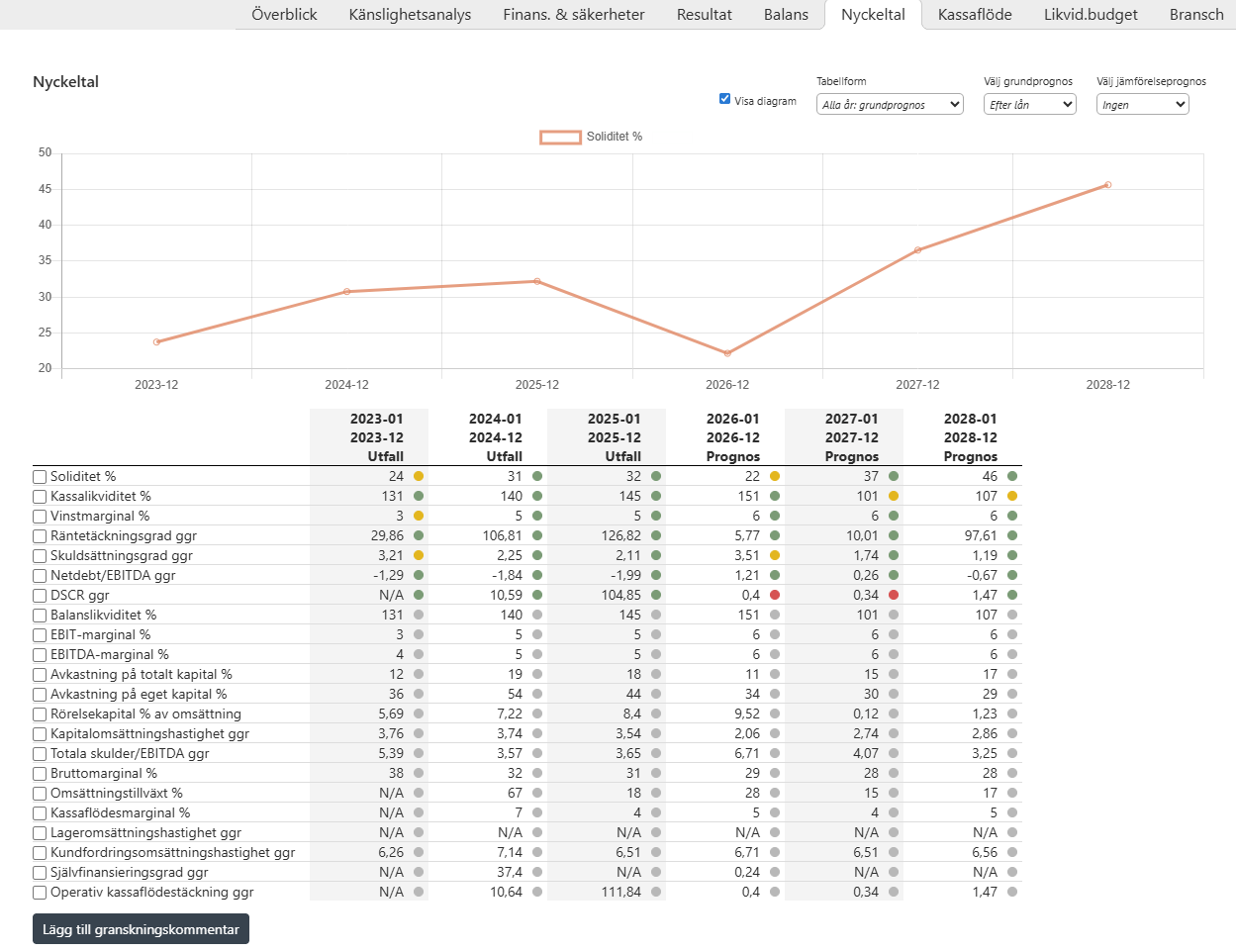
The presented key figure ratios are set in relation to which level is judged to be a good or less good outcome for each key figure.
The limit values for Green, Yellow and Red are the levels that Vitec in analysis and research defined as good, ok or less good / bad and the levels are as below for each key figure:
Key figures | Green | Yellow | Red |
Cash liquidity % | > (larger than) 120 | 90 -120 | < (less than) 90 |
Solidity % | > 30 | 30 -15 | < 15 |
Profit margin % | > 5 | 2 - 5 | < 2 |
Interest coverage ratio | > 3,8 | 2 – 3,8 | < 2 |
Debt / equity ratio | > 2,3 | 2,3 – 5,7 | < 5,7 |
Netdebt/EBITDA | 0 - 2 | 2 – 4 | < 0 if negative EBITDA > 4 |
DSCR | > 1,25 | 1 - 1,25 | < 1 |
Which threshold values are used for a KPI depends on the bank’s settings. The application also supports bank-specific threshold handling for industries / branches.
Description of the key figures
Kassalikviditet (Cash liquidity)

Definition: Current assets excluding inventory and work in progress as a percentage of current liabilities.
A current asset is an asset that is continuously consumed, sold, or converted into liquid funds. Examples of current assets are accounts receivable, inventory items, and cash and cash equivalents in different forms. Current liabilities are liabilities with a short maturity, less than one year. Examples of current liabilities are accounts payable, employees’ accrued vacation pay, and overdraft facilities.
Interpretation: This KPI gives an indication of the company’s short-term payment readiness.
Soliditet (Solidity)

Definition: A measure of how large a share of the company’s total assets has been financed with equity.
Interpretation: This KPI measures the company’s long-term stability and payment capacity, and shows to what extent it is financed by its owners. High solidity indicates that a large part of the company’s assets has been financed with equity. The lower the solidity, the more indebted the company is. The result should be compared with the industry standard, as this indicates what relationship between equity and total capital is considered standard in the industry in which the company operates.
Vinstmarginal (Profit margin)

Definition: Operating profit plus financial income as a percentage of net sales.
Interpretation: By calculating the profit margin, you can see how much of revenue is used for interest costs and profit. This KPI can be used to compare the efficiency of the business with other similar companies. No consideration is given to how the companies are financed, which means profitability becomes the focus of the comparison. This KPI is sometimes also called profit percentage.
Räntetäckningsgrad (Interest coverage ratio)

Definition: A measure of the company’s ability to pay interest on its outstanding debt.
Interpretation: This KPI measures the company’s capacity to generate, through its operations and financial income, a sufficient surplus to cover its financial costs.
Skuldsättningsgrad (Debt / equity ratio)

Definition: A measure of how large a share of the company’s assets has been financed through loans compared with equity.
Interpretation: The debt / equity ratio shows to what extent the company is financed with borrowed capital and measures the relationship between debt and equity. The higher the ratio, the higher the financial risk.
Netdebt/EBITDA

Definition: Net debt to EBITDA is a debt ratio that shows how many years it would take for a company to repay its debt if net debt and EBITDA remain constant.
Interpretation: If a company has more cash than debt, the ratio may be negative, which is positive. However, if the negative outcome is due to negative EBITDA, i.e. the company is operating at a loss, that is negative.
DSCR (Debt Service Coverage Ratio)

Definition: Measure of repayment ability for interest and amortization.
Interpretation: A value above 1 means that cash flow covers debt service.
Balanslikviditet (Current Ratio)

Definition: Current assets as a percentage of current liabilities.
Interpretation: Measure of short-term payment readiness including inventory.
EBIT-marginal (EBIT margin)

Definition: Operating profit as a percentage of revenue.
Interpretation: Shows operating profitability before financial items.
EBITDA-marginal (EBITDA margin)

Definition: EBITDA as a percentage of revenue.
Interpretation: Shows cash generation from operating activities before depreciation and amortization.
Avkastning på totalt kapital (Return on assets, ROA)

Definition: Operating profit in relation to total assets.
Interpretation: Measure of how efficiently the assets are used.
Avkastning på eget kapital (Return on equity, ROE)

Definition: Profit in relation to equity.
Interpretation: Measure of the owners’ return.
Rörelsekapital % av omsättning (Working capital as a percentage of revenue)

Definition: Working capital as a percentage of revenue.
Interpretation: Shows how much capital tie-up the business requires.
Kapitalomsättningshastighet (Asset turnover ratio)

Definition: Revenue per unit of total capital.
Interpretation: Measure of efficiency in the use of capital.
Totala skulder/EBITDA (Total debt / EBITDA)

Definition: Debt ratio based on adjusted debt.
Interpretation: Indicates the repayment burden relative to operating profit before depreciation and write-downs.
Bruttomarginal (Gross margin)

Definition: Gross profit as a percentage of revenue.
Interpretation: Shows the margin after direct cost of goods sold.
Omsättningstillväxt (Revenue growth)

Definition: Percentage change in revenue between periods.
Interpretation: Shows the growth rate in sales.
Kassaflödesmarginal (Operating Cash Flow Margin)

Definition: Operating cash flow as a percentage of revenue.
Interpretation: Shows how well revenue is converted into cash flow.
Lageromsättningshastighet (Inventory turnover ratio)

Definition: How many times inventory is turned over during a period.
Interpretation: A higher value means faster inventory turnover.
Kundfordringsomsättningshastighet (Accounts receivable turnover ratio)

Definition: Revenue in relation to accounts receivable.
Interpretation: A higher value indicates faster payments from customers.
Självfinansieringsgrad (Self-financing ratio)

Definition: Ability to finance investments with own cash flow.
Interpretation: A higher value means less dependence on external financing.
Operativ kassaflödestäckning (Cashflow Coverage Ratio)

Definition: Cash flow coverage of financial costs and amortizations. OCF / (net financial items + amortizations).
Interpretation: A higher value means stronger debt servicing capacity.